
Last updated October 30, 2026
 Wrought iron
 Wood & steel frame
 Farm & ranch
 Sliding driveway gates
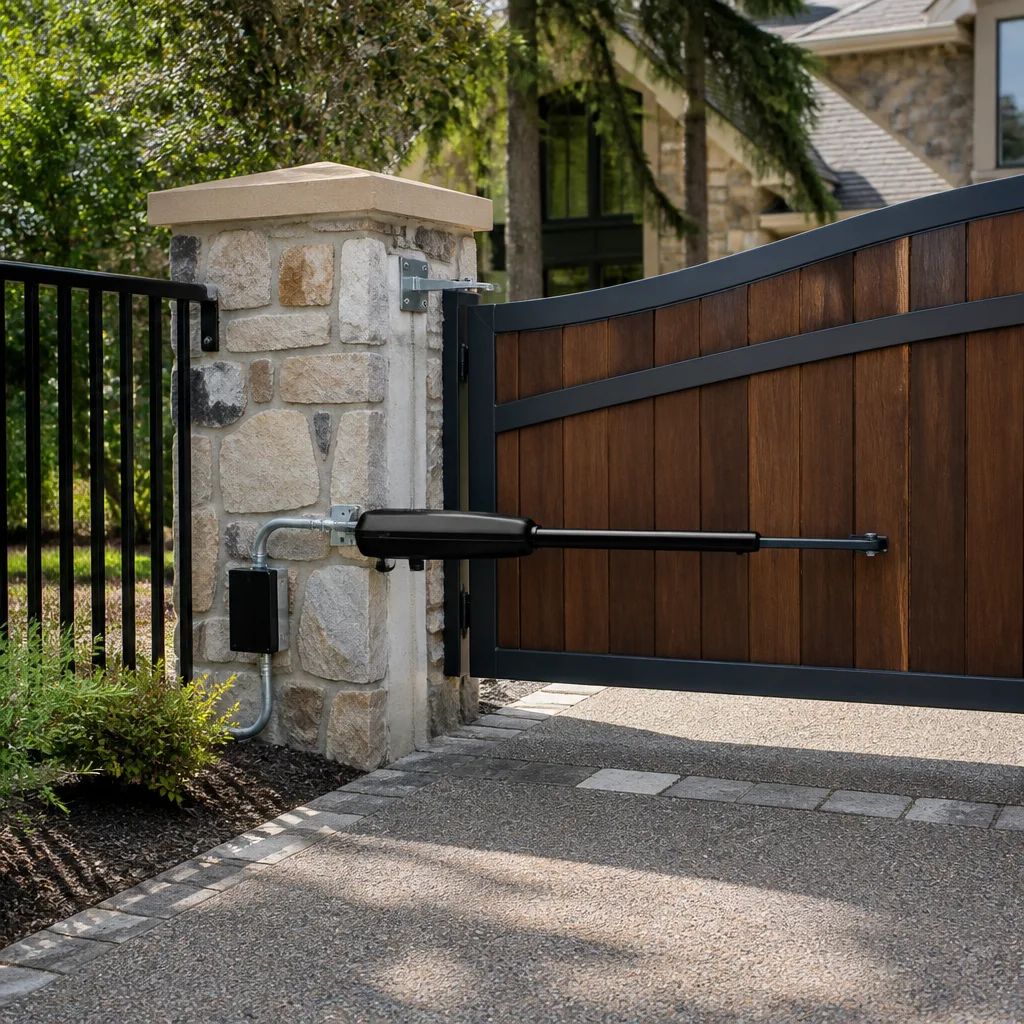 LiftMaster operators
Free on-site gate assessment - hinges, posts, and your LiftMaster or Nice gate operator checked before anything is quoted
The assessment is free and the quote is the invoice.
Get your free estimateGate Repair Cost Breakdown: The Ontario Homeowner’s Reference for 2026
Here’s a number most Ontario homeowners never hear until the second service call: roughly 30% of the automatic gate repairs we perform are corrections of a previous misdiagnosis. The first technician replaced a part that wasn’t actually the failure point, the gate worked for three weeks, and then the same symptom returned. What looks like a simple repair bill on paper was actually a diagnostic fee, a wrong part, a second diagnostic fee, and then the correct repair. This guide exists so you can read a gate repair quote the way a specialist does: by component, by labor hour, and by what the technician’s truck tells you about what happens next. We’re going to walk through actual 2026 Ontario market pricing, the failure points most often misdiagnosed, and the threshold where repair stops making financial sense. We’re Ontario Gate Company, and gates are the only thing we work on.
Quick Answer
Gate repair in Ontario, CA typically costs between $125 and $900 for most component-level repairs in 2026, with the median job landing around $280. Control board replacements run $250 to $700 including labor, motor or operator swaps run $350 to $1,100, and mechanical fixes like hinge or wheel replacement run $125 to $400. The single largest cost variable is whether the technician correctly identifies the failed component on the first visit, because every return trip adds a second diagnostic charge to the same underlying problem.
Styles & brands we work with
Table of Contents
- Component-Level Pricing: What Ontario Gate Technicians Actually Replace in 2026
- Why Gate Specialists Bill Differently Than Handymen in Ontario
- The Hidden Cost of Misdiagnosis: What a Wrong First Repair Really Adds
- When Repair Cost Crosses the Replacement Threshold
- What a Legitimate Written Estimate Should Include
- Brand-Specific Failure Points: What Your Operator Is Telling You
- Ontario-Specific Factors That Affect Gate Repair Cost
- Preventive Maintenance: What It Costs and What It Prevents
Component-Level Pricing: What Ontario Gate Technicians Actually Replace in 2026
When we say “operator repair” on an invoice, that line item can mean a $40 capacitor swap or a $600 control board replacement. The honest breakdown is in the components. And because we stock gate-specific parts rather than ordering them per job, the price a Ontario homeowner sees should reflect the part, the labor, and the fact that the technician already knew what to bring.
These are the market ranges we see in Ontario for 2026. They reflect parts cost plus typical labor for a single-visit repair on a residential gate system:
Control Boards by Brand
| Component | Parts Range | Typical Labor | Total Range |
|---|---|---|---|
| LiftMaster control board | $180 – $400 | 1 – 1.5 hrs | $280 – $550 |
| FAAC control board (residential) | $200 – $450 | 1 – 1.5 hrs | $300 – $600 |
| BFT control board | $150 – $380 | 1 – 1.5 hrs | $250 – $530 |
| Viking control board | $220 – $500 | 1 – 2 hrs | $320 – $700 |
| Linear control board | $160 – $420 | 1 – 1.5 hrs | $260 – $570 |
| Ghost Controls control board | $140 – $350 | 1 – 1.5 hrs | $240 – $500 |
Boards fail for predictable reasons: power surges from Inland Empire summer brownouts, moisture intrusion in enclosures that were sealed years ago, or capacitor degradation from direct sun exposure on south-facing Ontario properties. A board that costs $400 wholesale is not worth $400 if the technician spends two hours guessing whether it’s actually the problem. This is where brand familiarity changes the math: a gate repair in Ontario technician who knows a Viking board’s failure signatures diagnoses it in 20 minutes, not two hours.
Motors and Operators
| Component | Parts Range | Typical Labor | Total Range |
|---|---|---|---|
| Residential swing gate motor | $250 – $700 | 2 – 3 hrs | $450 – $1,000 |
| Slide gate operator (residential) | $300 – $900 | 2 – 4 hrs | $500 – $1,300 |
| Gearbox assembly | $180 – $450 | 1.5 – 2.5 hrs | $330 – $700 |
| Capacitor replacement | $20 – $60 | 0.5 – 1 hr | $70 – $160 |
Here’s the counterintuitive part most homeowners never hear: a $40 capacitor can produce the exact same symptom as a $350 motor failure. Gate won’t open, hums briefly, stops. That’s a capacitor on its way out about 40% of the time and a motor winding failure about 35% of the time on LA-area residential systems, the remaining quarter being limit switch or wiring issues. The technician who replaces the motor first because “that’s what it usually is” just cost you $500 when you needed an $80 fix.
Loop Detectors, Safety Sensors, and Accessories
| Component | Parts Range | Typical Labor | Total Range |
|---|---|---|---|
| Loop detector module | $80 – $200 | 0.5 – 1 hr | $130 – $300 |
| Photo eye / safety sensor pair | $60 – $180 | 0.5 – 1 hr | $110 – $280 |
| Keypad or card reader | $90 – $300 | 0.5 – 1 hr | $140 – $400 |
| Remote transmitter (replacement) | $40 – $90 | 0 – 0.5 hr | $40 – $140 |
Loop detectors are the unsung failure point on slide gates across Ontario industrial parks and gated residential communities. A failing loop causes the gate to close on cars, refuse to close, or cycle erratically. It’s a $80 to $200 part solving what looks like a much more expensive problem, but only if the technician tests the loop before assuming the board is fried.
Mechanical Hardware
| Component | Parts Range | Typical Labor | Total Range |
|---|---|---|---|
| Gate hinges (residential pair) | $40 – $150 | 1 – 2 hrs | $140 – $350 |
| Slide gate wheels / rollers | $50 – $200 | 1 – 1.5 hrs | $150 – $350 |
| Gate sag kit / anti-sag frame | $80 – $250 | 2 – 3 hrs | $280 – $550 |
| Chain or belt drive replacement | $60 – $220 | 1 – 2 hrs | $160 – $420 |
Mechanical wear is where Ontario’s heat and fine dust take their toll. Hinges on a south-facing wrought iron gate expand and contract through summer cycles that routinely push past 100°F, and the fine particulate from Santa Ana wind events works into bearing surfaces. We’ve pulled apart hinge pins in Ontario that looked fine from the outside but had ground themselves into ovals inside.
The key takeaway: your repair quote should name a component, not a symptom. “Fix gate opening problem” is not a quote. “Replace LiftMaster LA400 control board, P/N K74-38233, 1.5 hours labor” is a quote you can compare, verify, and hold someone to.
Why Gate Specialists Bill Differently Than Handymen in Ontario
Ontario gate repair labor rates for 2026 typically range from $85 to $150 per hour depending on the company’s specialization, with specialists clustering at the higher end. A general handyman might charge $60 to $80 per hour. That $25 to $70 per hour difference is not markup. It’s the cost of what’s on the truck and in the technician’s head before the service call starts.
Here’s what the rate difference actually buys you on an electric gate repair in Ontario:
- Diagnostic speed. A gate specialist has seen a hundred LiftMaster and FAAC and BFT failures with the same symptom. Diagnosis that takes a generalist 90 minutes of internet searching and phone calls takes a specialist 20 minutes of testing. You’re paying for confidence, not time.
- Parts on the truck. We stock gate-specific components: control boards, capacitors, limit switches, photo eyes, loop detector modules. A handyman does not. When the part is on the truck, the repair happens today. When it’s not, you pay a second trip charge.
- Warranty coverage. A specialist’s labor warranty on a board replacement means something because the specialist knows the board was the actual problem. A generalist who swapped a part on a guess may warranty the part but not the diagnosis, and that distinction matters when the gate fails again in a month.
- Safety compliance. Automatic gate systems in California fall under UL 325 and ASTM F2200 safety standards. Photo eyes, reversing edges, entrapment zones. A gate specialist checks these as part of every repair. A handyman typically does not know the standards exist.
There’s a reason this trade has a specialization curve. An automatic gate operator is an electro-mechanical system with line voltage, low-voltage control wiring, a moving structure weighing 300 to 1,500 pounds, and safety devices that are legally required to function. When someone tells us they’ve had four different technicians look at the same gate, the pattern is usually the same: all four were generalists applying generic troubleshooting to brand-specific equipment.
The Hidden Cost of Misdiagnosis: What a Wrong First Repair Really Adds
In our experience across Ontario, a misdiagnosed gate repair adds 60% to 150% to the total cost of solving the actual problem. Here’s the math on a typical case:
- First visit, generalist technician: diagnostic fee $75 to $95, conclusion is “probably the board,” board ordered, first visit total: $90 (diagnostic only).
- Second visit, board installed: board cost $280, labor $120, trip charge $50, total: $450. Gate works for three weeks.
- Gate fails again. Actual problem was a failing capacitor stressing the board, or a misaligned limit switch, or a loop detector feeding bad signal.
- Third visit, correct diagnosis: another diagnostic fee $90, correct repair $250 to $400.
Total spent: $880 to $1,030. Correct first-visit repair from a specialist who stocks the parts: $250 to $550. The gap is entirely in the misdiagnosis, and the homeowner paid for a part they did not need.
The pattern we see most often: a technician concludes “the board is bad” because the board is the most expensive component and the easiest to blame. But boards receive inputs from limits, loops, photo eyes, and keypads. A bad input looks like a bad board unless you test upstream. Testing upstream is what separates Ontario Gate Company home repair calls from the ones we’re called to fix afterward.
Ask any technician this one question before they touch your gate: “What tests confirmed that part is the failure?” If the answer is “it’s usually that,” you’re about to pay for a guess.
When Repair Cost Crosses the Replacement Threshold
The repair versus replace decision on a gate or operator is arithmetic, not intuition. Here’s the rule of thumb we use when advising Ontario homeowners:
If the cost to repair exceeds 50% of the cost to replace the component with a new equivalent, replace it. For an operator (motor, board, gearbox as one unit), the replacement cost including installation typically ranges from $1,200 to $2,800 for residential systems in Ontario, $3,000 to $8,000 for commercial slide operators.
Applied examples:
- Scenario one: Your 9-year-old LiftMaster residential swing operator needs a motor ($450 parts, $200 labor) and the board is showing signs of capacitor swelling ($300 parts, $150 labor). Repair total: $1,100. New operator installed: $1,400 to $1,800. Repair consumes 61% to 79% of replacement cost, and you’re left with a 9-year-old gearbox and aging wiring. Replace the operator.
- Scenario two: Your 6-year-old Ghost Controls opener needs a $160 capacitor and a limit switch adjustment. Repair total: $220. New operator: $1,400. Repair is 16% of replacement cost. Repair it and expect another 4 to 6 years of service.
- Scenario three: Your 14-year-old Linear slide operator has a failed board, worn drive chain, and the motor shows high current draw under load. Repairs add up to $950. New operator with modern safety features: $2,500 to $3,200 installed. Repair is 30% to 38%, which is borderline, but the 14-year-old system lacks current UL 325 safety features. A new gate installation in Ontario brings the system current and resets the maintenance clock.
Two more factors specific to Ontario:
- Parts availability for older systems. Brands like Viking and Linear support their legacy lines for a long time, but once a board goes out of production, the remaining stock commands a premium. If your board price has doubled in the last three years, that’s a signal the system is nearing end of support.
- Safety compliance. A 15-year-old operator that works fine mechanically but lacks modern photo eyes or reversing edges should be retired regardless of repair cost. The upgrade cost is a compliance cost, not an optional improvement.
What a Legitimate Written Estimate Should Include
A gate repair estimate from a Ontario company should fit on one page and answer five questions without you having to ask. If any of these are missing, you’re looking at a placeholder, not a price:
- Itemized parts with part numbers. Not “control board.” The exact part number. If the technician won’t tell you the part number before ordering, the parts price is not verifiable. Part numbers also tell you whether you’re getting a genuine manufacturer board or a third-party equivalent.
- Labor hours separated from parts cost. You have a right to know what you’re paying for the technician’s time versus the component itself. A lump-sum “operator repair: $650” hides the ratio. Ask for the split.
- Diagnostic fee treatment. Does the diagnostic fee get credited toward the repair if you approve the work? Many Ontario companies credit it, some don’t. The estimate should state which applies before you sign anything.
- Warranty terms in writing. How long is the parts warranty? How long is the labor warranty? What voids the warranty? If the estimate says “warranty included” without specifying, ask. A 90-day labor warranty on a board replacement is standard; a 1-year parts warranty from the manufacturer is standard. Anything less on labor signals low confidence in the diagnosis.
- Scope of the repair. What exactly will be done, in what order, with what outcome defined. “Restore gate to automatic operation” is a scope. “Try replacing the board” is not.
You should expect the price to be quoted and agreed before any work starts. Not after. A company that won’t commit to a number before turning a screwdriver is transferring risk onto you.
Brand-Specific Failure Points: What Your Operator Is Telling You
We’re trained on nine major gate and operator brands, and each of them has a personality when it fails. Knowing your brand’s failure signature shortens diagnosis from hours to minutes.
BFT residential swing operators, for example, have a known failure point in certain capacitor circuits after 5 to 7 years of Southern California heat exposure. The symptom is intermittent non-start: gate works fine 80% of the time, then refuses to move, then works again. Homeowners describe it as “temperamental.” It’s almost always the capacitor bank or a cold solder joint on the control input, not the motor.
Linear slide operators are workhorses across Ontario industrial parks, but their limit switch assemblies accumulate dust and corrosion at the chassis entry point. The gate still opens and closes, but it stops short or overtravels. That’s a mechanical limit issue, a $60 to $120 fix, and it is frequently misdiagnosed as a control board problem because the board receives conflicting limit signals.
Viking commercial operators tolerate heavy-use cycles, which is why they dominate gated communities and commercial lots throughout the Inland Empire. Their failure mode after years of service is typically in the gear reducer, presenting as a gate that moves but sounds strained, or one that creeps slower over months. By the time the gate stops, the gearbox has been failing for a year.
Ghost Controls residential openers are popular in Ontario’s newer tract home communities, where solar-powered or low-voltage operators fit the retrofitted driveway gate. The weak point in our experience is their photo eye alignment and the app-to-controller communication module. Homeowners reset the app, the gate works briefly, then fails again. The fix is usually hardware, not software.
This is what single-trade specialization means in practice. When we dispatch a technician to a Viking gate in Ontario, that technician has worked on Viking gates in Ontario before. They’re not arriving with a generic multimeter and a prayer. They’re arriving knowing the three most likely failure points for that brand, that age, and that usage pattern, and they brought the parts for all three.
Ontario-Specific Factors That Affect Gate Repair Cost
Ontario, California gate repair pricing is shaped by factors that homeowners in coastal LA or the high desert don’t experience in the same combination. Here’s what makes the Ontario market distinct:
Heat and Dust
Ontario sits in the Inland Empire’s thermal belt, where summer highs routinely exceed 100°F and Santa Ana winds deliver fine particulate that infiltrates enclosures. Control boards and capacitors degrade faster in sustained heat, and dust accumulation inside operator housings accelerates bearing and limit switch wear. Ontario gate technicians expect to clean and inspect, not just swap parts.
Wind Loading
Santa Ana wind events put lateral loads on swing gates that the Inland Empire’s inland location experiences more intensely than coastal communities where ocean breezes dominate. A gate that binds in windy conditions is often a hinge alignment or post settlement issue, not an operator problem. Diagnosing it correctly requires a technician who understands what Ontario wind does to gate geometry.
Permit Context
The City of Ontario’s building department regulates gate installations that affect public right-of-way or exceed certain heights, but most residential driveway gate repairs on existing permitted structures do not trigger new permit requirements. Where a repair becomes a replacement, setback and height requirements for the specific Ontario zoning district can apply. A gate company that works routinely in Ontario already knows these parameters.
Mix of Property Types
Ontario combines postwar single-family neighborhoods, newer gated communities near the 15 and 60 freeway corridors, and a substantial industrial and logistics presence along the airport district. That means the same repair company in Ontario might service a Ghost Controls opener on a suburban driveway gate in the morning and a Viking slide operator at an Ontario Ranch distribution center in the afternoon. The breadth of brands and systems concentrated in one city is part of why a gate-only company with cross-brand training has an advantage here.
Preventive Maintenance: What It Costs and What It Prevents
A preventive maintenance visit on a residential automatic gate in Ontario typically costs $120 to $250 depending on the system’s complexity. That visit includes hinge lubrication, limit check, photo eye alignment, operator housing cleaning, capacitor inspection, and a full operational cycle test. On commercial systems, expect $250 to $450 per visit, scheduled quarterly or semi-annually depending on cycle frequency.
Here’s the cost-benefit math that matters:
- A $180 maintenance visit catches a swollen capacitor before it fails. Replacement cost during maintenance: $40 to $80. Replacement cost after failure: $160 to $300, plus the cost of whatever the capacitor took out with it.
- A $200 maintenance visit regreases hinges before metal-on-metal wear begins. Hinge replacement: $140 to $350. Gate sag repair after prolonged neglect: $280 to $550.
- A $250 commercial maintenance visit identifies a failing loop detector before it starts opening and closing on cars. That repair costs less than $300. The liability of a gate that closes on a vehicle is a different number entirely.
The systems that last 15 and 20 years in Ontario are not the expensive ones. They’re the maintained ones. Gates are outdoor machinery. They need the same preventive attention as any other machine that lives outside in a hot, dusty climate. The companies that install gates and then disappear lose customers to the companies that install, service, and maintain the same gate over its full lifecycle. That’s how we’ve built our service model: install it once, then keep it running.
Common Mistakes to Avoid
- Accepting a symptom-based quote instead of a component-based one. “Fix gate opening problem: $450” is not a quote. It’s a guess dressed up as a price. Demand the part number, the labor hours, and the warranty terms.
- Replacing the most expensive component first. Ontario homeowners sometimes push for a motor or board replacement because they’ve had so many failures they assume the system is shot. A $40 capacitor or a $60 limit switch often resolves the symptom for a fraction of the cost. Insist on a diagnosis, not a parts cannon.
- Ignoring the second opinion after a recurrent failure. If your gate failed, was repaired, and failed again within 90 days, that’s not bad luck. That’s a missed diagnosis. Get a different set of eyes, ideally a gate specialist.
- Waiting until the gate fully fails to schedule service. Grinding sounds, slow operation, intermittent non-response, drifting limit positions. These are warning signs that precede total failure by weeks or months. Repairing at the warning stage costs less than repairing at the failure stage because a failure takes downstream components with it.
- Hiring by hourly rate alone. A $65-per-hour handyman who spends three visits chasing a misdiagnosis costs far more than a $125-per-hour gate specialist who fixes it in one visit. Calculate total cost, not hourly cost.
- Not asking whether the estimate covers safety compliance. California automatic gate systems must meet UL 325 and ASTM F2200 safety standards. If your repair company doesn’t check photo eyes and reversing edges as part of the repair, the gate works but is non-compliant. That’s a liability question for Ontario homeowners with pool gates or driveway gates adjacent to sidewalks.
- Replacing a gate because the operator failed. The gate structure (hinges, frame, steel, hardware) and the operator (motor, board, controls) are separate systems with separate lifespans. A dead operator on a structurally sound gate means a new operator, not a new gate. We’ve seen Ontario homeowners quoted full gate replacements when the actual need was an $800 operator swap.
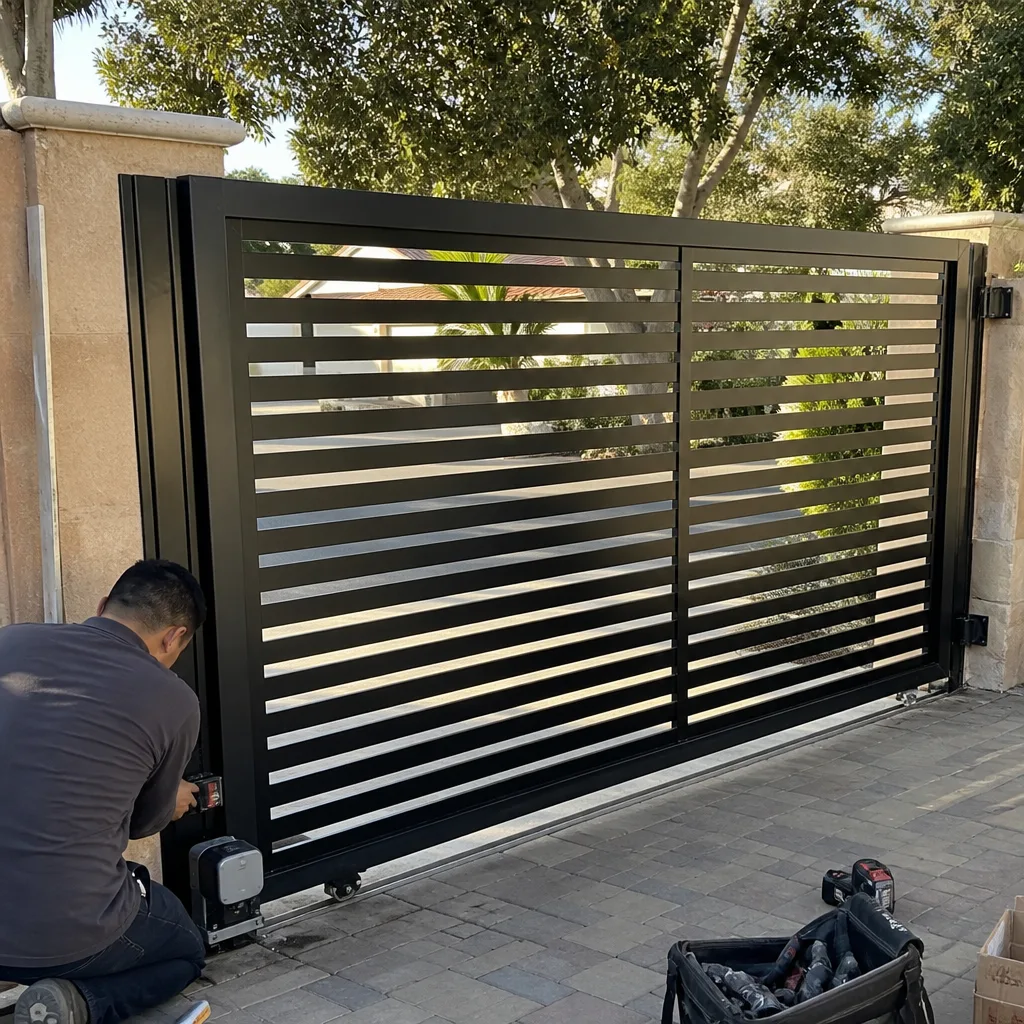
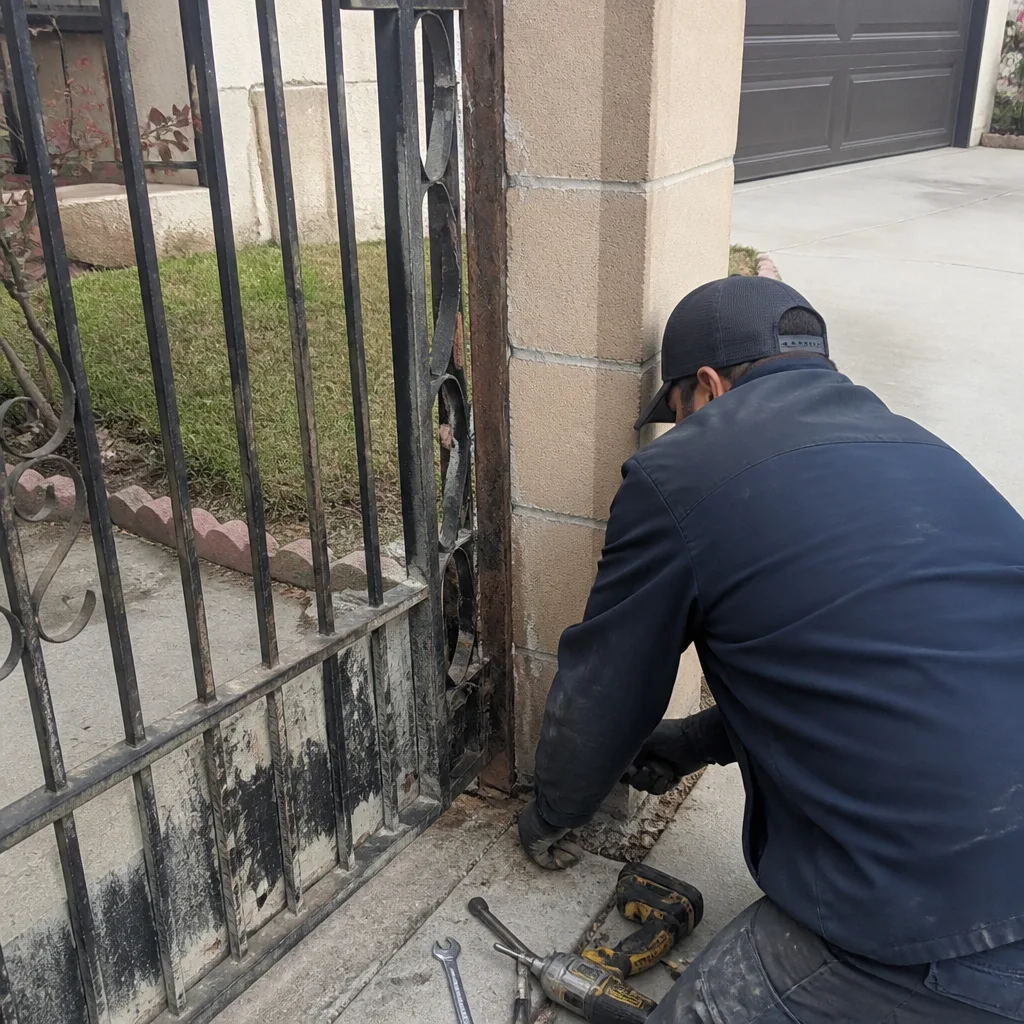
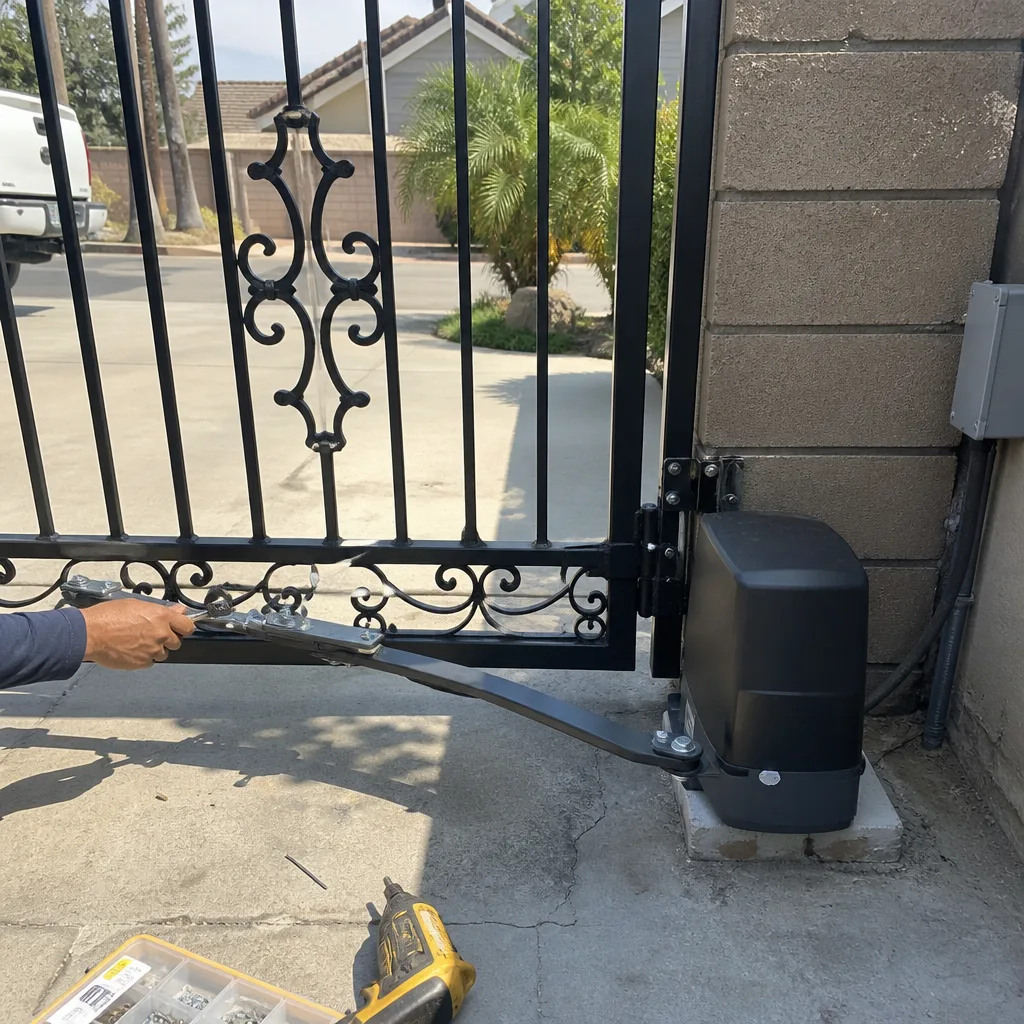
See the difference
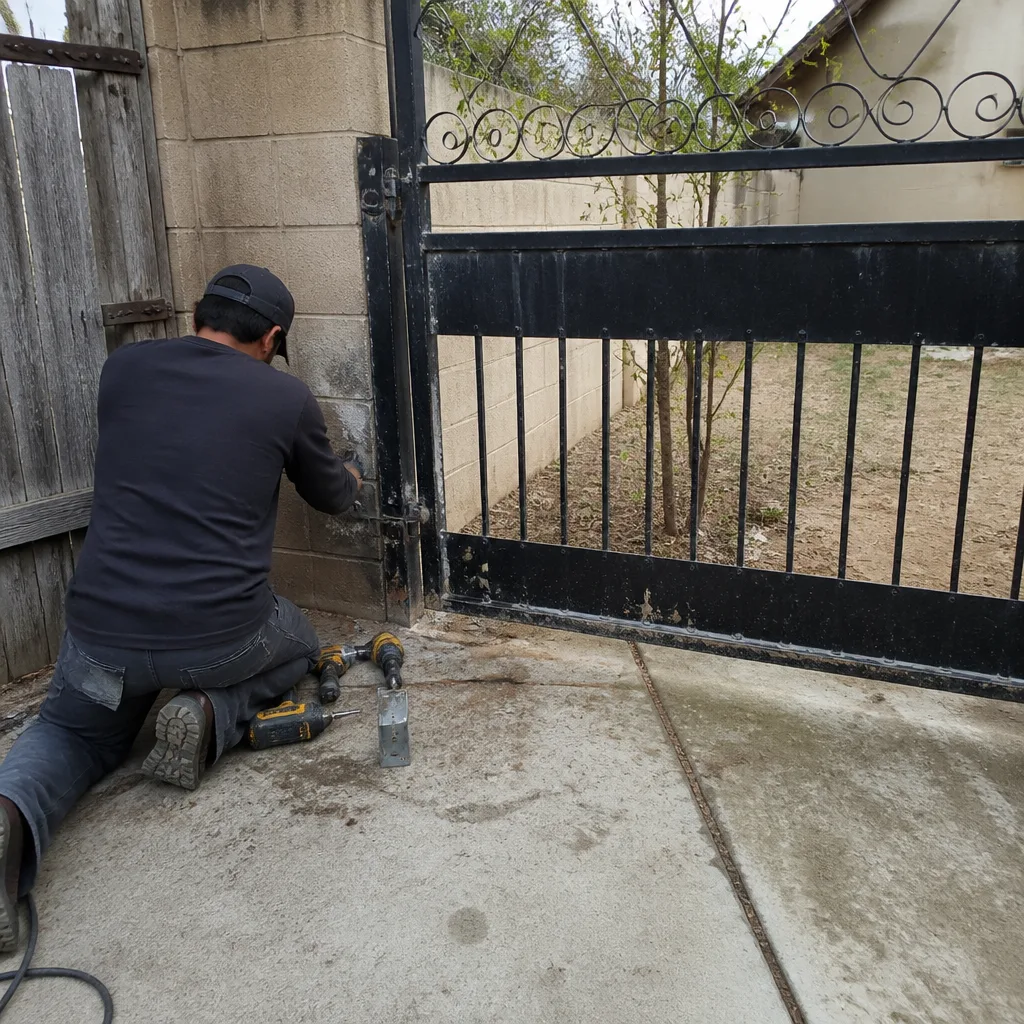 Before
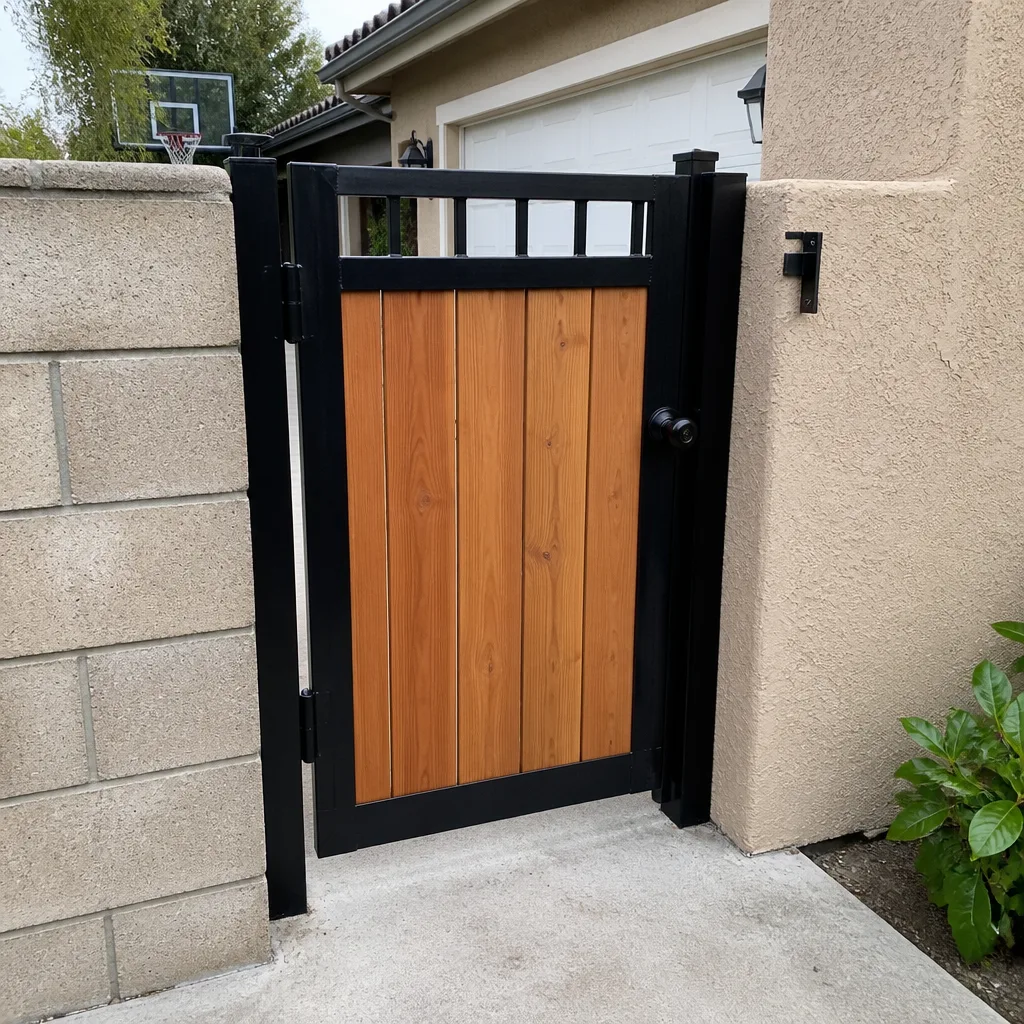 After
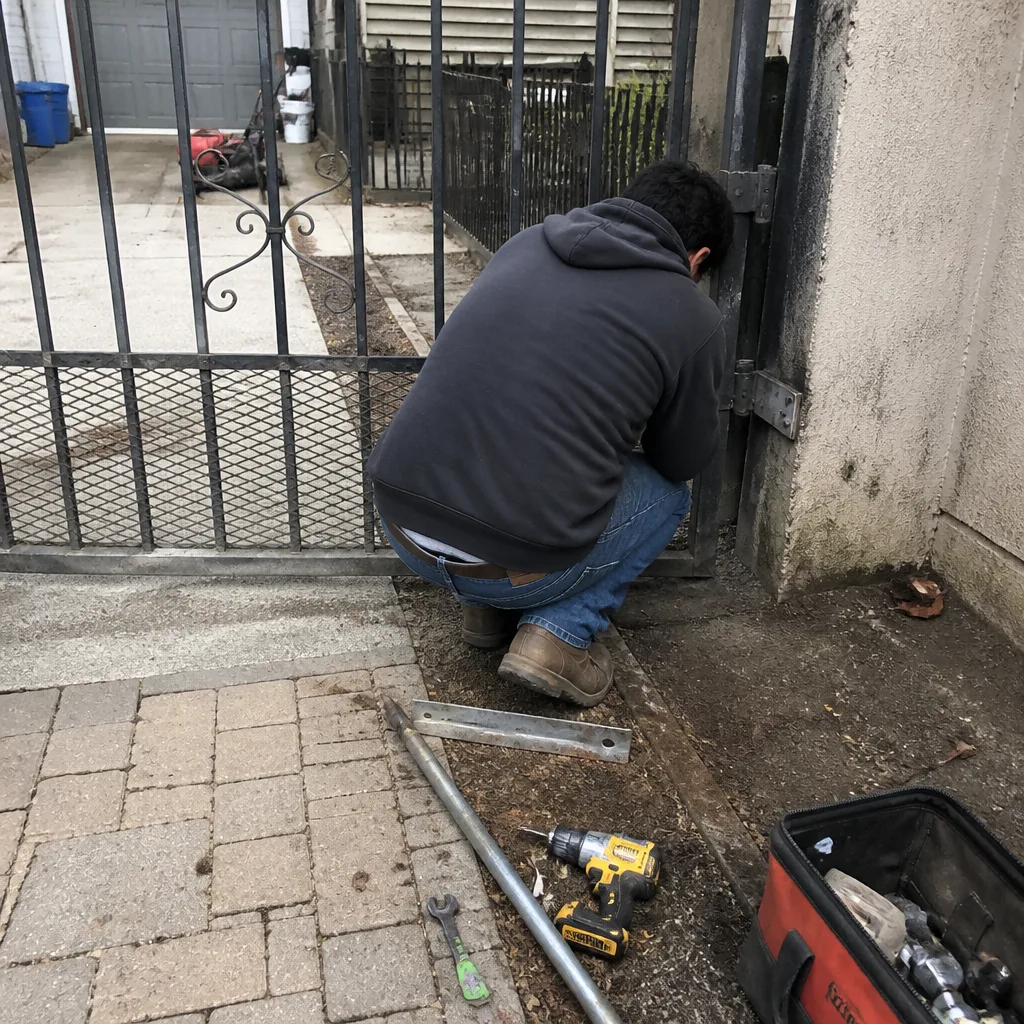 Before
 After
 Before
 After
When to Call a Professional
Automatic gates involve line voltage, moving structures weighing hundreds of pounds, and safety devices that exist to prevent entrapment. These are not hobby repairs. Call a professional if your gate is moving erratically, making grinding or straining sounds, failing to close reliably, reversing on its own, or if you can see visible sag, cracked hinges, or exposed wiring at the operator. If the gate has stopped responding entirely, a board diagnosis is beyond the scope of a YouTube tutorial. Ontario Gate Company offers free estimates in Ontario, and our technicians arrive with gate-specific parts and brand-specific training. Call (855) 707-3634 to schedule a diagnostic visit. We quote the price before any work begins, and the price you approve is the price you pay.
Frequently Asked Questions
Gate repair in Ontario typically costs between $125 and $900 for component-level repairs in 2026. Control board replacements run $280 to $700, motor replacements run $450 to $1,100, and simple mechanical fixes like hinge or wheel replacement run $125 to $400. The final cost depends on which component failed and whether the technician correctly diagnoses it on the first visit. Call (855) 707-3634 for an exact quote on your specific system, estimates are free.
A control board replacement in Ontario costs between $250 and $700 depending on the brand. LiftMaster, BFT, Linear, and Ghost Controls boards range from $140 to $420 in parts with 1 to 1.5 hours of labor. Viking commercial boards run higher, reaching $700 installed for some models. The part number matters because aftermarket boards can cost less upfront but fail sooner.
Same-day gate repair in Ontario depends on the failure and our current dispatch schedule. Because we stock gate-specific parts including boards, capacitors, photo eyes, and limit switches, most common repairs are completed in a single same-day visit. For a same-day service inquiry in Ontario, call (855) 707-3634 as early as possible so we can reserve a dispatch window.
A full gate installation in Ontario includes the gate structure, operator or motor, control board, safety devices (photo eyes or reversing edges), keypad or access control integration, power run, and final setting of limits and close speeds. Installation pricing generally starts around $1,200 for a basic residential operator replacement on an existing gate and $3,500 and up for a complete new gate and operator system, with commercial slide systems running considerably higher depending on length and weight.
If your gate worked after a repair and then failed within 30 to 90 days, the most likely explanation is that the previous technician replaced a component that was affected by the failure, not the component that caused it. For example, a failing capacitor can damage a board; replacing only the board restores operation until the capacitor fails again and takes the new board with it. This is the single most common pattern we correct on Ontario repairs, and it’s why our diagnostic process tests upstream causes before replacing downstream symptoms.
Yes, electric gate repair in Ontario with access control is a core part of what we do. We work on operators from LiftMaster, FAAC, BFT, Linear, Viking, Ghost Controls, DoorKing, Elite, and Mighty Mule, including integration with keypads, card readers, telephone entry, and vehicle loop detectors. The failure is often in the wiring between the access device and the operator board, not in either component individually. We test the whole signal path. Call (855) 707-3634 for a free estimate.
The Bottom Line
Gate repair in Ontario costs what it costs because of components and diagnostic accuracy, never because of gate brands alone. The homeowner who understands this reads quotes differently: part numbers instead of symptom descriptions, labor hours instead of lump sums, and a clear-eyed view of whether repair or replacement makes more financial sense. Prevention through maintenance runs $120 to $250 per visit and routinely prevents $500 to $1,000 repairs. Misdiagnosis is the most expensive line item on any invoice, and the best defense against it is hiring a company that sees gates as the entire job, not one line on a service menu. That’s Ontario Gate Company. One trade, one phone number: (855) 707-3634.
Written by the team at Ontario Gate Company, serving Ontario since 2011.