
Last updated October 30, 2026
 Wrought iron
 Wood & steel frame
 Farm & ranch
 Sliding driveway gates
 LiftMaster operators
Free on-site gate assessment - hinges, posts, and your LiftMaster or Nice gate operator checked before anything is quoted
The assessment is free and the quote is the invoice.
Get your free estimateGate Repair Emergency Preparedness Guide for Ontario Homes
Automatic gates fail most often when they’re needed most: during a blackout, as Santa Ana winds tear through the Inland Empire, or on a 105-degree July afternoon when the operator board overheats and refuses to respond. The 2020 wildfire evacuations made the stakes painfully clear: across the Inland Empire, evacuation routes were slowed partly because residents couldn’t open their automatic gates during a power failure. They had never located the manual release. They had never tested it. When minutes mattered, they were locked on the wrong side of their own fence. This guide is written for Ontario homeowners and property managers who don’t want to be that person, and builds on our Gate Repair Maintenance Checklist for Ontario Homeowners. We’ll walk through the predictable triggers that cause most gate emergencies in Ontario, how to prepare for each one, and what to do in the first 10 minutes of a failure. Some of this you can handle yourself. Some of it needs a gate specialist. Knowing which is which is the entire point.
Styles & brands we work with
Quick Answer
A gate emergency in Ontario rarely comes out of nowhere. Power outages, Santa Ana wind events, and heat-related operator failures cause the overwhelming majority of calls we respond to. The single most important preparation step is knowing how to locate and operate your gate’s manual release before an emergency happens, because during an evacuation or a blackout, nobody has time to read a manual. Every automatic gate sold in Ontario includes a manual release mechanism required by code. If you can find it, test it, and reset it in under two minutes, you’re ahead of 90% of homeowners we meet.
Table of Contents
- Manual Release Operation: The Skill That Saves Evacuations
- Power Outage Protocol: Battery Backup and What It Can Actually Do
- Post-Santa Ana Wind Inspection: What to Check Before Re-Enabling Automatic Operation
- When a Gate Emergency Is a Safety Emergency
- How to Communicate Gate Access to Emergency Responders in Ontario
- The Five Most Predictable Gate Failures in Ontario’s Climate
- Emergency Prep Checklist: What to Do This Weekend
- Common Mistakes to Avoid
Manual Release Operation: The Skill That Saves Evacuations
Every automatic gate operator includes a manual release. It’s a mechanical bypass that disconnects the gate from the motor so you can push or pull it open by hand. This release exists precisely for moments when power is out, the motor has failed, or an emergency requires immediate exit or entry. In our experience across Ontario and the wider Inland Empire, fewer than one in five homeowners has ever operated their manual release before an emergency. That’s a problem, because the release on a LiftMaster isn’t in the same place as the release on a FAAC, and the Viking mechanism works differently from the DoorKing. Here’s what you need to know for the four most common operator brands in Ontario:
LiftMaster Residential Operators
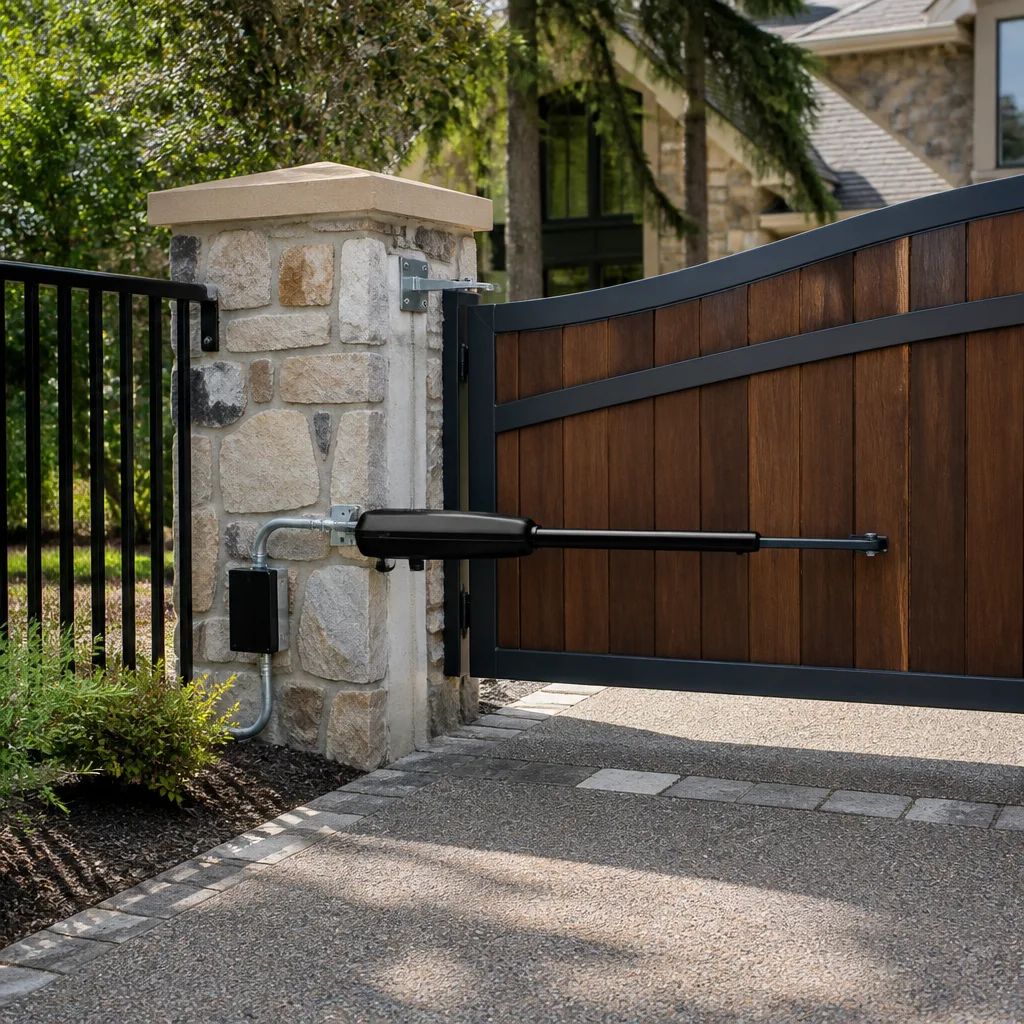
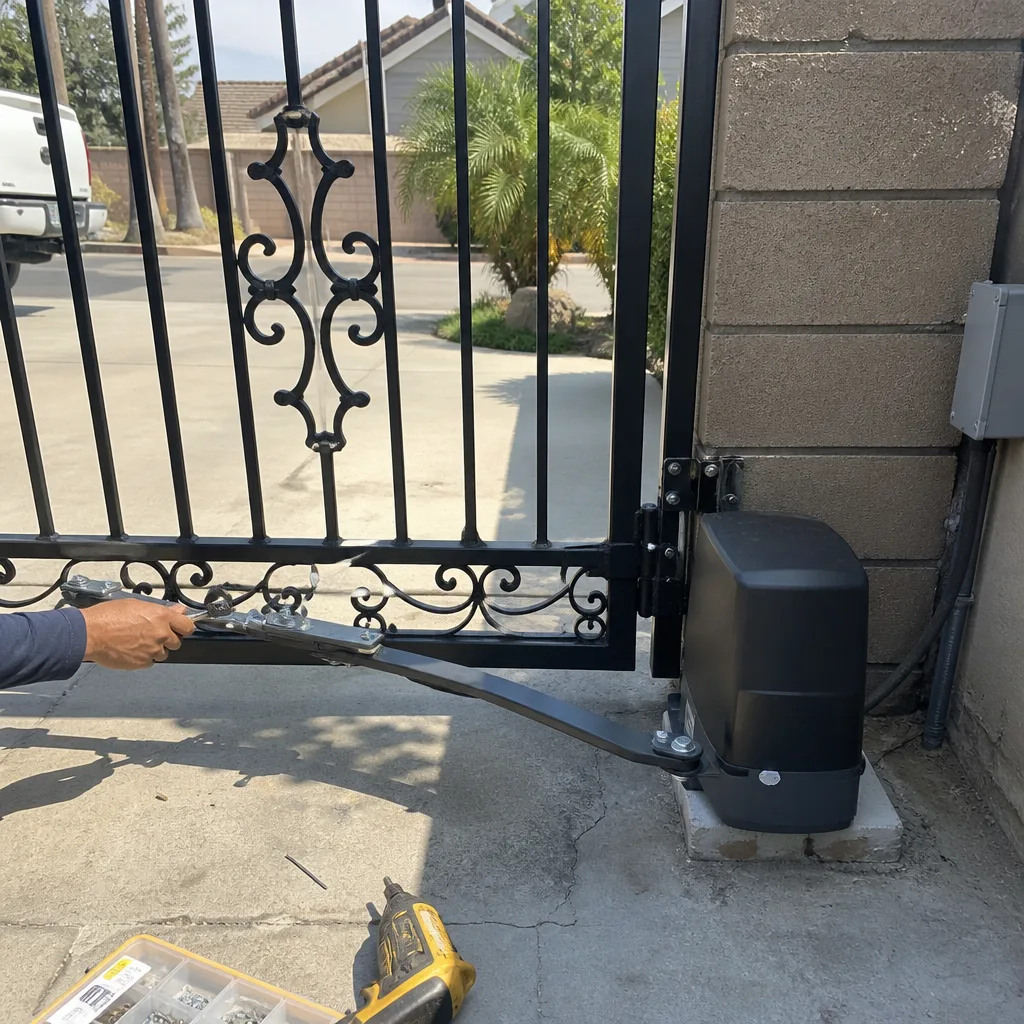
LiftMaster swing and slide gate operators typically use a manual release lever or keyed release located on the operator housing itself, near where the arm connects to the gate. Look for a small red or yellow handle, or a keyhole marked “MANUAL.” Pull the handle or insert the key and turn it a quarter turn. You should hear a mechanical disengagement. The gate will now move freely. For LiftMaster slide gates, the release often disconnects a chain or belt from the motor sprocket. After the emergency, re-engage by reversing the motion and running the operator through a full open-close cycle to confirm it re-latched correctly. If it grinds without engaging, don’t force it. Call a gate technician.
FAAC Operators
FAAC operators, common on residential swing gates in Ontario, use a manual release that’s usually a keyed cylinder built into the operator arm or the gearbox housing. You insert the key, rotate it counterclockwise, and the hydraulic or electromechanical lock disengages. Some FAAC models require you to hold the key in the released position while moving the gate, rather than leaving it unlocked. This catches people off guard when they’re already stressed. Test yours on a calm Saturday so the motion becomes muscle memory. To reset, turn the key back clockwise and confirm the gate no longer swings freely. FAAC operators will typically re-engage automatically on the next powered cycle if the key has been returned to the locked position.
Viking Operators
Viking operators, used on both residential and light commercial gates throughout the Inland Empire, generally use a manual release located on the side of the operator cabinet or integrated into the gate bracket. On Viking swing gate operators, look for a small lever or pull chain near the pivot point. On Viking slide operators, the release is often a lever that lifts the drive wheel or disengages the chain idler. Viking’s design philosophy favors simplicity, so the release is usually visually obvious once you know where to look. The challenge is that in an emergency, when the gate won’t move and you’re panicking, obvious isn’t obvious. This is why we tell every Ontario customer to locate the release on the day the gate is installed or first serviced, not the day it fails.
DoorKing Operators
DoorKing is the most common brand we see on Ontario driveways with slide gates, and the manual release protocol matters here because DoorKing operators use a chain-driven trolley system. The release is typically a lever on the operator that disengages the chain from the sprocket, or a keyed disconnect on the gate itself. DoorKing also makes a fail-secure lock option that requires manual unlocking before the release will function, which means two steps instead of one. If your DoorKing gate won’t move after pulling the release, check for a separate mechanical lock. In an evacuation, that second step matters. Test it monthly. It takes 60 seconds.
We recommend a simple drill: once a month, walk to your gate, operate the manual release from memory, confirm the gate moves freely, then reset the release and run one automatic cycle. This single habit turns an emergency procedure into something you can do in the dark, in smoke, with a phone in one hand. If your release is stiff, corroded, or won’t engage cleanly, that’s a repair item. A release that doesn’t work in an emergency is worse than no release, because it gives false confidence. Our Gate Repair in Ontario service regularly restores manual releases that have seized from dust, rust, or years of neglect.
Power Outage Protocol: Battery Backup and What It Can Actually Do
Blackouts in Ontario come from three main sources: summer grid strain during heat waves, Santa Ana winds that knock down lines, and the occasional equipment failure from Southern California Edison. When power drops, an electric gate with a healthy battery backup should continue operating for a limited number of cycles. The key word is limited. A healthy backup battery typically provides somewhere between 10 and 30 open-close cycles, depending on the operator, the gate’s weight, and the battery’s age. A degraded battery might give you two cycles, or none. Most homeowners discover this in the worst possible moment.
Here’s the monthly protocol we recommend for any Ontario home with an automatic gate:
- Locate the battery. It’s usually in the operator cabinet or a separate weatherproof box near the gate. If you don’t know where it is, find it this week.
- Check the battery’s age. Most gate backup batteries are sealed lead-acid or lithium and have a service life of 3 to 5 years. If you can’t remember when it was replaced, it’s probably overdue.
- Run a test. Turn off the breaker that powers the gate (or unplug the operator). The gate should continue operating. Count how many full open-close cycles it completes before slowing or stopping.
- Listen for changes. A healthy battery cycle sounds the same as a powered cycle. A weak battery makes the motor sound labored, and the gate may move slower than normal.
- Restore power. Once the test is complete, restore the breaker and run one full cycle to confirm the operator recharges the battery and returns to normal function.
What runtime should you expect? A healthy backup on a residential swing gate should handle at least 10 full cycles. If your gate is heavy, oversized, or a slide gate with a long travel distance, expect fewer. If the battery is more than four years old, replace it proactively. The cost of a replacement battery is a fraction of the cost and disruption of a gate that won’t open during an evacuation. Our Electric Gate Repair in Ontario team replaces backup batteries during routine service calls and can test yours if you’re not sure about its condition.
One more Ontario-specific factor: extreme heat shortens battery life. Inland Empire summers routinely push ambient temperatures above 100 degrees, and inside a metal operator cabinet, it can reach 130 or more. Heat accelerates the chemical degradation of lead-acid batteries specifically. If your battery is three years old and has survived two full Inland Empire summers, treat it as a candidate for replacement even if it still tests okay in cooler months.
Post-Santa Ana Wind Inspection: What to Check Before Re-Enabling Automatic Operation
Santa Ana winds are a fact of life in Ontario. They blow in from the desert, push dust and debris into every mechanical component, and apply sustained lateral force to gates that can shift hinges, knock sensors out of alignment, and bend brackets. After a significant wind event, we hear from dozens of Ontario homeowners whose gates won’t close, won’t open, or slam unexpectedly. Many of these calls could be prevented or at least minimized with a quick post-wind inspection before putting the operator back on automatic.
Here’s what to check in order, after any Santa Ana event with sustained winds above 30 mph:
- Debris in the track or gate path. Wind pushes leaves, branches, trash, and even plastic bags into slide gate tracks and swing gate paths. Any obstruction can cause the operator’s obstruction sensor to trip, stopping the gate mid-cycle or reversing it unexpectedly. Clear the full path, including the area the gate sweeps when opening.
- Sensor alignment. Photo-eye safety sensors are mounted on posts or columns near the gate. Wind can knock a post slightly out of alignment, or coat the sensor lens with dust. Misaligned or dirty sensors cause the gate to refuse to close or to reverse immediately after starting. Wipe the lenses with a clean cloth and check that the sensors are pointed directly at each other. If the alignment is visibly off, that’s a service call.
- The gate’s resting position. Walk around the gate and check that it sits square in its closed position. Wind can shift a swing gate on its hinges or force a slide gate off its track. If the gate is hanging lower on one side, dragging on the ground, or visibly tilted, do not run the operator. A misaligned gate can damage the operator, bend the drive mechanism, or fail catastrophically mid-cycle.
- Operator housing securement. Check that the operator cabinet or housing hasn’t been hit by flying debris or shifted on its mounting plate. If the operator moves when the gate runs, kill power and call for service.
- Manual release integrity. Wind-driven vibration can loosen manual release levers or partially disengage them. Confirm the release is fully seated in its normal operating position before running an automatic cycle. A partially disengaged release can cause the operator to run while the gate doesn’t move, or the gate to drift freely.
If any of these checks reveals a problem, switch the operator to manual mode (or cut power entirely) and leave the gate in a safe position: fully open if you need access, or fully closed and manually locked if security is the priority. Then call for service. Our Gate Repair in Ontario calls after wind events are usually quick diagnoses: a misaligned sensor, a bent bracket, a shifted hinge. What makes them quick is that we see the same failure patterns every wind season. We know what a Santa Ana wind does to a Viking slide gate versus a DoorKing swing gate, and we arrive knowing where to look first.
When a Gate Emergency Is a Safety Emergency
Not every gate failure is a safety emergency. Some are inconveniences: the remote won’t pair, the keypad is dead, the gate opens slower than it used to. But some failures create real hazards, and Ontario homeowners need to know the difference. A gate that won’t open during a fire or medical emergency is a life-safety issue. A gate that slams shut unexpectedly or reverses without an obstruction is a physical safety issue. A gate that won’t stay closed and drifts open is a security issue. How you respond should match the severity.
Conditions where the gate should be manually locked open or closed rather than repaired in place while awaiting service:
- A gate that can’t be opened manually. If the operator has failed and the manual release doesn’t work, you have a trapped-vehicle situation. This is especially serious for homes where the gate is the only vehicle access point. The gate should be secured safely (locked open if emergency access is needed, or locked closed if the property will be unattended) and the operator should be powered down.
- A gate that opens unexpectedly. If the gate begins opening on its own, or opens partially and stops, a control board fault, a stuck relay, or a loop detector malfunction may be the cause. A gate that opens by itself is a security failure. Cut power at the breaker and call for service.
- A gate that reverses direction mid-cycle. This usually indicates a sensor fault, but it can also indicate a mechanical binding that the operator’s force-sensing is interpreting as an obstruction. A gate that reverses while closing can crush or strike anything in its path if the sensors are also malfunctioning. Treat this as a safety emergency.
- Visible damage to hinges, brackets, or the gate itself. A cracked weld, a bent hinge, a leaning gate post: these are structural issues that can fail suddenly. The gate should not be operated automatically or manually until inspected.
- Sparks, smoke, or burning smell from the operator. Cut power immediately. Do not open the operator cabinet. This is an electrical fault that could be a fire hazard.
In any of these scenarios, the first step is always to remove the risk: power down the operator, secure the gate in the safest position for your property, and get on the phone. Ontario Gate Company specializes exclusively in gates, and every technician arrives with the diagnostic equipment and parts needed to assess the failure on the spot. We don’t do fencing on the side, we don’t do general contracting, and we don’t learn about your operator model by reading the manual in your driveway. If it’s a gate, it’s what we do.
How to Communicate Gate Access to Emergency Responders in Ontario
Fire and police in Ontario need to get through your gate fast. If you have a power outage, an operator failure, or a medical emergency where you can’t reach the gate control, that access becomes a problem. Every minute a fire engine waits at a locked gate is a minute the fire grows. Every minute a paramedic waits is a minute a patient doesn’t get care. The city and the Ontario Fire Department have specific protocols for this, and homeowners who prepare their gates for responder access are doing the single most important thing for their own safety.
Ontario, CA participates in the Knox Box program. A Knox Box is a small, tamper-resistant safe mounted on a post or wall near the gate, containing a key or access device that allows firefighters and police to manually open the gate. The box can only be opened by a key held by the fire department. This is not a suggestion for commercial properties; it’s a requirement for many multi-tenant and gated communities in Ontario, and strongly recommended for any residential property with an automatic gate, especially properties set back from the road or with long driveways.
Here’s how to make sure emergency responders can reach your property:
- Install a Knox Box if you don’t have one. The box should be mounted in a visible location near the gate, typically on a post or wall adjacent to the driveway. The Ontario Fire Department can confirm the correct mounting height and location for your property type.
- Put a gate key or access fob inside, not just a house key. The Knox Box should contain whatever device manually opens your gate: a physical key for the manual release, a spare remote, or an access card. If responders can open the box but can’t operate the gate, the box failed its purpose.
- Label clearly. The box should be visible from the street, not hidden behind landscaping. A reflective marker or sign helps responders spot it at night or in smoke.
- Test the access annually. Once a year, open the Knox Box yourself during a maintenance visit, confirm the key or remote inside actually works on your current gate system. You’d be surprised how often a homeowner changes gate operators or remotes and forgets to update the Knox Box contents.
- Keep the manual release accessible from the outside. If responders can’t open the gate with the access device, they need a way to manually release it. A keyed manual release that can be operated from the outside of the property, or a clearly marked release point, gives them that option.
If you’re not sure whether your gate meets Ontario’s access standards, your gate specialist can do a responder-access review during a routine service call. Our Gate Installation in Ontario service includes access considerations for new systems, and our repair team can retrofit Knox Box compatibility, external release points, and responder-friendly controls on existing gates. This isn’t bureaucratic compliance for its own sake. It’s the difference between a 3-minute response and a 15-minute response when something is on fire.
The Five Most Predictable Gate Failures in Ontario’s Climate
Ontario’s climate is hard on gate equipment. We get the full Inland Empire treatment: summer temperatures above 100 degrees, Santa Ana winds with dust and debris, occasional heavy rain, and the fine particulate dust that seems to coat everything within 48 hours of it being cleaned. We see the same failures repeatedly, and they cluster around specific conditions. Knowing these patterns means you can spot problems early, before they become emergencies.
1. Heat-Related Control Board Failures
Control boards don’t like extreme heat. Inside a metal operator cabinet on a 105-degree Ontario afternoon, the internal temperature can easily exceed 140 degrees. Components degrade, solder joints crack, and relays stick. The failure often shows up as intermittent behavior first: a gate that works in the morning and refuses to respond in the afternoon, or a gate that stops mid-cycle and resets. If your gate becomes unreliable on hot days, the control board is a prime suspect. Ventilated cabinets and shade can help, but eventually the board may need replacement. We diagnose this on site, not over the phone, because heat failures can also mimic sensor faults and wiring issues.
2. Wind-Driven Sensor Misalignment
Photo-eye safety sensors are delicate instruments. A strong Santa Ana gust can shift a mounting post by a quarter inch, and that’s enough to break the beam alignment. The result: a gate that won’t close, or a gate that reverses immediately after starting to close. We see this constantly after wind events. It’s one of the quickest fixes we do, but it’s also one of the easiest for a homeowner to check themselves. If your gate refuses to close after a wind event, clean the sensor lenses and check alignment before calling for service. If the problem persists, the sensor may be damaged or the post may have shifted enough to require remounting.
3. Battery Failure in Summer Heat
As mentioned earlier, backup batteries degrade faster in Ontario’s summer heat. A battery that tests fine in March may be dead by August. The failure mode is silent: everything works normally while power is on, and the battery gives no indication that it’s lost capacity until the power goes out and the gate won’t move. The only reliable detection is a monthly battery test. For Ontario homeowners, we recommend marking your calendar for the first Saturday of each month: test the battery, check the manual release, inspect the gate path. It’s ten minutes that prevents a genuine emergency.
4. Chain and Sprocket Wear on Slide Gates
Slide gates are common on Ontario properties with wider driveways, and they use chain or belt drive systems that wear over time. As chains stretch and sprockets wear, the gate develops play, moves unevenly, or begins to make a chattering sound in operation. Left unaddressed, a worn chain can jump the sprocket, which usually happens mid-cycle and leaves the gate stuck partway open or closed. Regular lubrication and periodic chain tension inspection catch this before it becomes an emergency. This is standard maintenance for your DoorKing or Viking slide gate, and it’s part of what we do on every service call in Ontario.
5. Loop Detector Failures After Rain
Vehicle loop detectors are buried under the driveway and sense the metal mass of a car to trigger automatic opening or keep the gate open while a vehicle is present. When heavy rain saturates the ground, failing loop detectors often reveal themselves: the gate opens for no reason, refuses to stay open when a car is waiting, or cycles erratically. The loop wire itself usually isn’t the problem; it’s a failed detector circuit or a broken connection at the junction box. Diagnosis requires specialized equipment, and loop repair often involves cutting and resealing a section of driveway, so it’s not a DIY fix. But if your gate behaves oddly after a heavy rain, this is likely the culprit.
Emergency Prep Checklist: What to Do This Weekend
We’ve covered a lot of ground. Here’s the condensed version: a single weekend of preparation that puts you ahead of the vast majority of Ontario homeowners when the next power outage, wind event, or heat wave hits.
- Locate and test your manual release. Find it, operate it, confirm the gate moves freely, and reset it. Do this until you can do it from memory. If you have a LiftMaster, FAAC, Viking, or DoorKing operator, the location is specific to your model. If you can’t find it or it doesn’t work, call us.
- Test your battery backup. Kill power to the gate and count how many full cycles it completes. If it’s under 10 cycles or the battery is more than 3 years old in Ontario’s heat, replace it proactively.
- Clear the gate path. Remove debris, trim back vegetation, and make sure the full travel path is clear in both directions.
- Clean sensor lenses and check alignment. A microfiber cloth and 30 seconds prevents the most common post-wind service call we get.
- Install or update a Knox Box. If emergency responders can’t access your property quickly, every other preparation is secondary.
- Write down your gate specialist’s number. In an emergency, you won’t want to search for it. Ontario Gate Company is at (855) 707-3634. We answer.
Common Mistakes to Avoid
- Waiting until the gate fails to read the manual. Manuals are dense and hard to navigate under stress. The time to learn your operator’s failure modes and release mechanism is now, not during a blackout. We see this mistake constantly in Ontario, and it costs people time when time matters most.
- Assuming the battery backup works without ever testing it. Backup batteries fail silently. The only way to know is to test. A homeowner who tests monthly will never be surprised by a dead battery during an evacuation. A homeowner who doesn’t test is making a bet with bad odds.
- Running the gate after wind damage without inspecting it first. A shifted hinge or a bent track can destroy an operator quickly. The $150 saved by skipping the inspection becomes a $2,500 operator replacement. We’ve seen this exact sequence play out across Ontario’s wind seasons.
- Calling a general contractor for gate repair. Gates are electromechanical systems with brand-specific failure modes, not just metal and hinges. A generalist who doesn’t know the difference between a Viking release mechanism and a DoorKing chain drive will waste your time and your money. We specialize exclusively in gates, which is why our diagnostic times are shorter and our first-visit fix rate is higher.
- Leaving the gate partially open “just in case.” A half-open gate confuses the operator’s limit logic, can cause repeated cycling, and burns out motors. If you need the gate open, open it fully and switch the operator to manual. If you need it closed, close it fully and lock it.
- Ignoring intermittent problems. A gate that works “most of the time” is telling you something. Intermittent failures are almost always a component on its way out. The repair is cheaper before it fails completely, and you avoid the emergency of discovering the failure at the worst possible time.
When to Call a Professional
Some gate problems are maintenance items you can handle yourself: cleaning sensors, clearing debris, testing the battery, operating the manual release. Others require a trained technician with gate-specific diagnostic equipment and parts. Call a professional when the gate reverses mid-cycle, when the operator makes grinding or chattering noises, when the control board shows visible scorching or swelling, when a chain or belt has jumped its sprocket, when a hinge or bracket has cracked or bent, or when you’ve tested the manual release and it simply doesn’t work. These are not situations where trial and error is safe or cost-effective. Ontario Gate Company offers Gate Repair services with free estimates in Ontario, and we arrive knowing the common failure points of every major brand we service. Call (855) 707-3634 to schedule a diagnostic visit. The diagnosis is specific, the quote is clear, and the fix is confirmed before we leave your property.
Frequently Asked Questions
Gate repair costs in Ontario vary widely depending on the failure: a sensor realignment might run under $200, while a control board replacement on a commercial operator can exceed $1,500. Most residential service calls fall in the $200 to $600 range. The price depends on the part, the labor time, and whether the failure is mechanical, electrical, or both. Ontario Gate Company provides a clear quote before any work begins, so you’ll know the cost before we start. Call (855) 707-3634 for a free estimate in Ontario.
Same-day gate repair in Ontario is usually possible for common failures like sensor misalignment, stuck manual releases, or battery replacement, provided we have availability in your area. More complex repairs, like control board replacement or loop detector work, may require parts ordering. We carry a broad inventory of gate-specific parts, covering LiftMaster, FAAC, BFT, Linear, Viking, Ghost Controls, DoorKing, Elite, and Mighty Mule, which improves our same-day fix rate compared to general repair companies that order parts per job. Call (855) 707-3634 and tell us what’s happening; we’ll give you a straight answer about timing.
Every automatic gate operator includes a manual release mechanism that disconnects the gate from the motor, allowing you to push or pull it open by hand. On LiftMaster operators, look for a red or yellow lever or keyed release on the operator housing. On FAAC operators, the release is usually a keyed cylinder on the operator arm. On Viking operators, look for a lever or pull chain near the pivot point. On DoorKing slide gates, the release disengages the chain from the sprocket. If you haven’t tested yours, do it now before you need it. If it won’t operate, call Ontario Gate Company at (855) 707-3634, and we’ll restore it.
Ontario Fire Department requires Knox Box access for many gated communities, multi-tenant properties, and commercial sites, and strongly recommends the same for high-setback residential properties with automatic gates. A Knox Box allows firefighters and police to access your property without waiting for someone to open the gate. The box should contain a working gate key, remote, or access device. If you don’t have one, contact the fire department for mounting requirements, or ask your gate installer to include Knox Box compatibility in the system design.
First, clear all debris from the gate path and the track or hinge area. Second, clean the photo-eye sensor lenses and check that the sensors are aligned directly at each other; wind often knocks them slightly off axis, which causes the gate to refuse to close or to reverse immediately. Third, check that the gate itself hasn’t shifted on its hinges or track. If those steps don’t resolve it, switch the operator to manual and call for service. Post-wind sensor misalignment is the most common gate issue we see after Santa Ana events in Ontario, and it’s usually a quick fix when caught early.
Backup batteries for gate operators typically last 3 to 5 years, but Ontario’s summer heat, with temperatures regularly above 100 degrees, can shorten that lifespan significantly. Heat accelerates chemical degradation inside sealed lead-acid batteries, and a battery that survives three full Inland Empire summers is often near the end of its usable life even if it still tests okay in cooler months. We recommend monthly testing: kill power to the gate and count the number of full open-close cycles before it slows. If it’s under 10 cycles, replace the battery. Call (855) 707-3634 to schedule a battery test and replacement in Ontario.
The Bottom Line
Most gate emergencies in Ontario aren’t random. They follow predictable triggers: the power outage that exposes a dead battery, the Santa Ana wind that knocks a sensor out of alignment, the heat wave that pushes a control board past its limit. Homeowners who prepare for those specific scenarios spend less time locked out, less money on emergency repairs, and less stress when something fails. The preparation is simple: know your manual release, test your battery monthly, inspect after wind events, and make sure emergency responders can access your property. None of this takes more than a few hours a year. All of it pays off when the next blackout or wind event arrives. If you’re in Ontario and your gate needs service, inspection, or emergency repair, call Ontario Gate Company at (855) 707-3634. For details on local requirements, see our guide to Gate Repair Permits, Codes & Inspections in CA: What You Need to Know. We specialize exclusively in gates, and we’ll help you get back in operation.
Written by the team at Ontario Gate Company home, serving Ontario since 2011.
See the difference
 Before
 After
 Before
 After
 Before
 After